

The Emerald Threat on the Horizon
In February 2023, the City of Moorhead’s Forestry Department found Emerald Ash Borer (EAB) larvae during its winter tree pruning. At the time of the February 2023 discovery, 36 states and the District of Columbia had found EAB in their borders.
Moorhead’s discovery of this invasive Asian beetle marked the closest EAB has been identified to the State of North Dakota, and the City of Bismarck, and potentially guarantees that the community will be faced with an EAB response in the near future.
EAB has been active in the United States since 2002 and has killed millions of ash trees since its discovery in southeast Michigan. It is likely to kill millions more. While it has expanded its territory, it largely moves slowly when not aided by humans transporting infected wood.
“The insect doesn’t move quickly from east to west because there is not continuous canopy cover,” said Bismarck City Forester Doug Wiles. “However, once the insect hits the river bottoms in the Fargo-Moorhead area, it’ll move north and south fairly quickly because of the abundance of ash trees it can jump to.”
Moving forward, the City of Bismarck has two plans in place to help manage an EAB infestation: a preparedness plan leading up to an infestation and a management plan dedicated to the post-infestation response.

Getting to know the Emerald Ash Borer
The Emerald Ash Borer gets its name from its deep green color. The insect has a darker emerald color along the majority of its body and may have a slightly lighter color around its head.
“It’s a very attractive beetle with dark green metallic coloring,” said Wiles. “But they are very, very small. They are usually a quarter-inch to a half-inch long and maybe one-sixteenth of an inch wide.”
During early fall, adult female beetles lay eggs in the bark crevasse. These eggs hatch in 7-10 days. The hatched larvae then chew through the bark and begin feeding in the portions of the tree that are actively growing and transporting food throughout the organism. Feeding continues throughout the fall. During winter months the larvae pupate and in the early spring, adult beetles emerge through a conspicuous D-shaped exit hole it chews in the bark of a tree. After the insect emerges, it flies to another tree and begins to feed, starting the process over.
What kills a tree is not the insect feeding on the canopy cover but the larvae feeding under the bark and creating serpentine galleries. As the larvae feed, they damage the layer of tissue in the wood that transports water and nutrients up and down a tree. Think of this damage like pinholes being poked up and down a straw, which makes it more challenging to drink liquid from a cup.
Interestingly, trees in their native Asia have adapted to this pest. However, trees in North America have not evolved the defense mechanisms necessary to withstand the presence of EAB and the damage EAB larvae create.

North Dakota’s harsh winter conditions may prove useful in EAB defense. Wiles said staff in Winnipeg, Manitoba, have reported that winter seems to have some impact on the Emerald Ash Borer and restricts some larvae from growing. Conversely, some investigations have shown that EAB larvae are beginning to adapt to the harsh northern climate and can survive in temperatures as cold as -50º F.
EAB Preparedness Plan
While the City of Bismarck’s EAB Preparedness Plan has evolved and changed in its decade-plus existence, its first iteration was instituted in 2012. The goal of this plan is to spread the cost of managing EAB over time. Guidelines are to hold off on treatments until the pest has been identified within 15 miles of a community. EAB is generally a slow-moving threat on its own, but those moves are accelerated when humans move infected wood into a community.
“We know that if we do nothing to manage EAB, the pest will kill every single ash tree,” said Wiles. “Prior to us investing a significant amount of money in EAB management, we are going to take a number of significant steps to reduce the cost needed when we do have an infestation.”
Core tenets of the plan include identifying trees that will be kept. These trees are identified by condition, location, or size. The larger a tree is, the more benefits it provides, compared to some of its smaller counterparts that would need years of growth to reach a similar status. Trees that conflict with utility infrastructure or future construction projects may be less valuable than trees in a less obstructive location. This identified roster may also include trees that have cultural or community significance. Trees that do not meet the criteria identified by the preparedness plan are slated for removal.
About 23% of the City of Bismarck’s urban forest is ash trees. This puts Bismarck in a good position compared to other communities in the state. While Fargo’s ash tree population is at about 19 percent and Moorhead’s ash tree population is at just about 23%, many smaller communities have a considerably higher ash tree proportion. Wiles’ goal is to get Bismarck’s ash tree population percentage below 20% before EAB is identified in the community, which means the removal of another 800 ash trees on boulevards. This number does not include trees managed by the Bismarck Parks and Recreation District or ash trees located on the river bottom or private property.

With hundreds of ash trees being removed from the right-of-way, the city and its residents are losing a significant number of assets and benefits provided by the trees. While pre-emptive removals will reduce the overall cost once EAB is found, it does not address the lost value or benefits that occur when a mature tree is removed. That is why the Forestry Division is planting replacement trees in boulevards that have had ash trees removed. The Forestry Division has funded this effort through strategic grant awards given by the North Dakota Forest Service. The goal is to replace every tree that has been removed. By replacing these trees, we are ensuring future generations will receive the benefits of having tree-lined streets.
Finally, as part of the EAB Preparedness Plan, $1 million has been earmarked for the initial management and response. This earmarked money allows for instantaneous removal and ash tree injection response when the pest is identified in the community.
Removal of Trees
To assist in reaching the removal goals, the City of Bismarck has established a contract with third-party entities to remove up to 200 ash trees this summer.
“We’re making a pretty big dent through the efficient use of general fund dollars,” said Wiles. “We’re going to spread the cost of management over time, and the goal is to have a small impact on property tax dollars.”
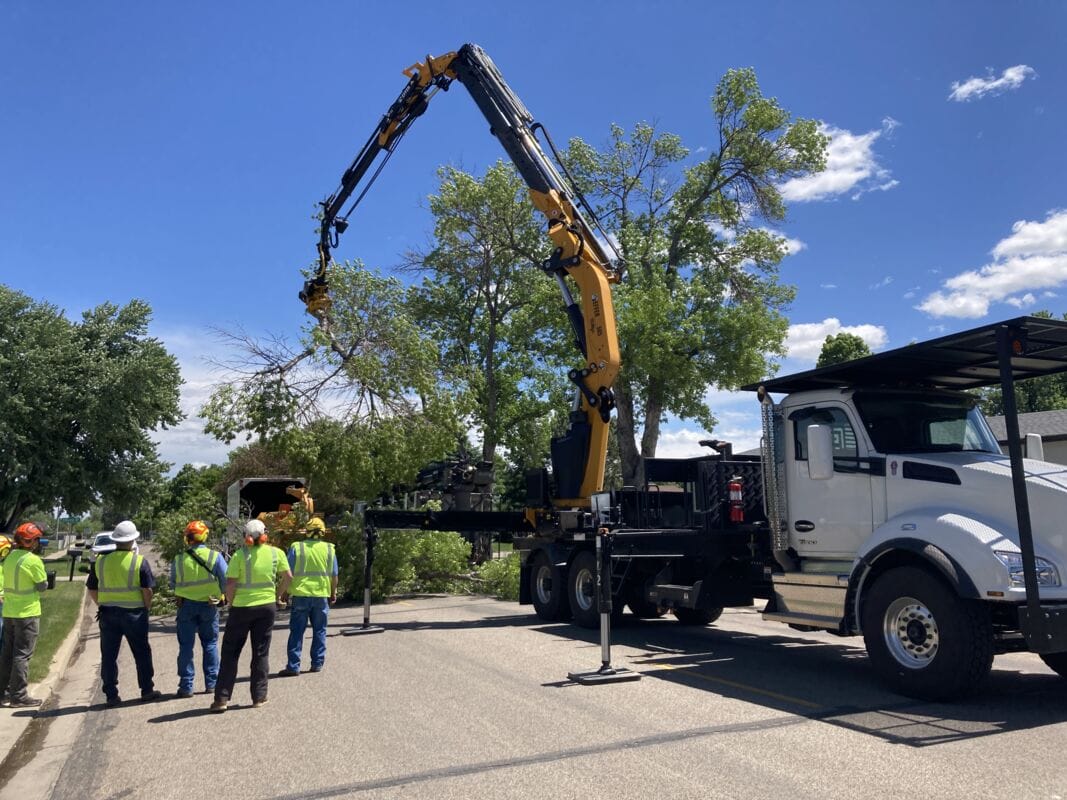
The Forestry Division also received funds to purchase a knuckle boom truck. This commercial-sized truck has a retractable hydraulic crane mounted on its chassis that has a grappling hand fashioned to one end. Underneath this grappling hand is a saw. The knuckle boom truck can be run by remote control from the ground and eliminates the need to have forestry staff working in a bucket. Additionally, when a tree is infested with EAB, the pest causes the structure of a tree to become brittle. If a tree is cut down, the impact of the trunk hitting the ground can cause it to shatter, sending wooden shards in every direction. With its ability to grasp, control, and move all portions of the tree trunk, the knuckle boom truck creates a safer and cleaner working environment and eliminates the majority of potential property damage.
“The knuckle boom truck looks like a Transformer,” said Wiles. “It’s a really cool piece of equipment that allows us to more safely and efficiently remove ash trees once they are infested. It is more efficient in that it reduces the number of staff and pieces of equipment needed on-site. This piece of equipment would replace the need for a boom truck on-site. We will just need to have this knuckle boom truck and a chip truck on-site.”

The grappling hand of the knuckle boom truck allows staff to place the sections of the tree directly into the chipper, or alongside the machinery if the chipper is in use. This eliminates staff having to drag and lift limbs, which has a direct impact on the number of injury claims filed by employees.
Replacing Ash Trees
Removing ash trees isn’t the end of the response to an EAB incident. Trees that are removed need to be replaced by a different species. However, this process is complicated by the logistics of an EAB response.
A tree infected with EAB should ideally be removed in the winter when the insect larvae are under the bark. Following the removal of the tree, stump grinders are used to eliminate the remainder of the tree and fresh trees are planted in the spring. At present staffing levels, it is expected to take about two months to remove 300 trees and about one month to plant 300 trees, in addition to ongoing monitoring efforts.
“This is going to be very complicated, and we will need to be creative in finding efficiencies,” said Wiles. “But we are in a good spot. We’ve worked hard over the last 10 years to reduce the number of ash trees overall and increase the diversity across our city landscape. It will be big news when EAB is discovered, and citizens will have the Forestry Division as a resource. Though we’re not going to inject or remove trees on private property, we can still provide best practices and next steps on how to address the tree.”
The City of Bismarck’s urban forest is mapped through GIS software. These maps allow staff to easily identify areas where ash trees are more prominent in Bismarck. Sections in the community south of Bismarck Expressway between Washington and Third Street, and a neighborhood north of Interstate Ave between Washington Street and Fourth Street going north to Calgary Avenue have dense ash populations. These areas of town may see the most change due to EAB.
We don’t know exactly how much time we have until EAB is in our community, but we also know we won’t be surprised by EAB.”
—Mike Schmitz
Next Steps for Trees, Next Steps for Staff
Some movements within the City of Bismarck’s organization chart are mixed in with the traditional responses of the City’s Forestry Division and an Emerald Ash Borer Response. In April 2024, Wiles, who had served as the City Forester for about 8 years, was appointed as the City’s Assistant City Administrator. This advancement creates a vacancy in the Forestry Division that is expected to be filled this summer. Until that individual is hired, Wiles will be spending time working between two roles, which can help shorten the learning curve for the individual hired as the new City Forester.
“It potentially could be a great benefit to the community,” said Wiles. “My goal is that the City hires someone who is a better forester than I am and has new ideas and more insight into what we can do to better evolve as a division and a city.”
EAB is a threat, that much is certain. This invasive insect can destroy a significant portion of Bismarck’s urban forest and alter the beauty introduced to this windswept prairie. But North Dakota also has the benefit of more than two decades of national response and more than a decade of local preparation. Bismarck’s plan, moving forward, is for no tree genus to make up more than 10% of the urban forest’s population.
We don’t know exactly how much time we have until EAB is in our community, but we also know we won’t be surprised by EAB. The City of Bismarck has invested in people and resources that will make our community stronger and more resilient. Together, we will be able to mitigate this threat and overcome the potential problems it poses.